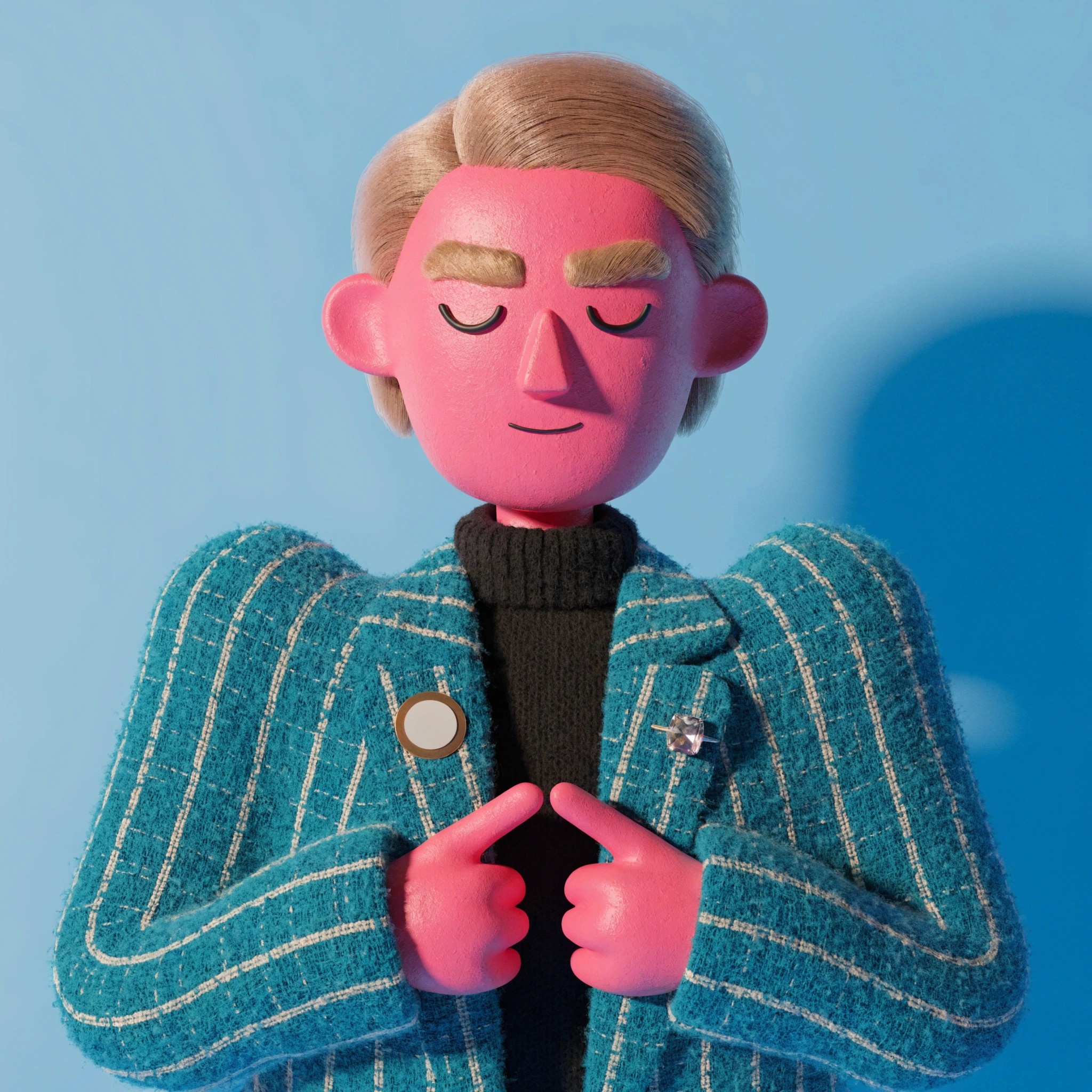
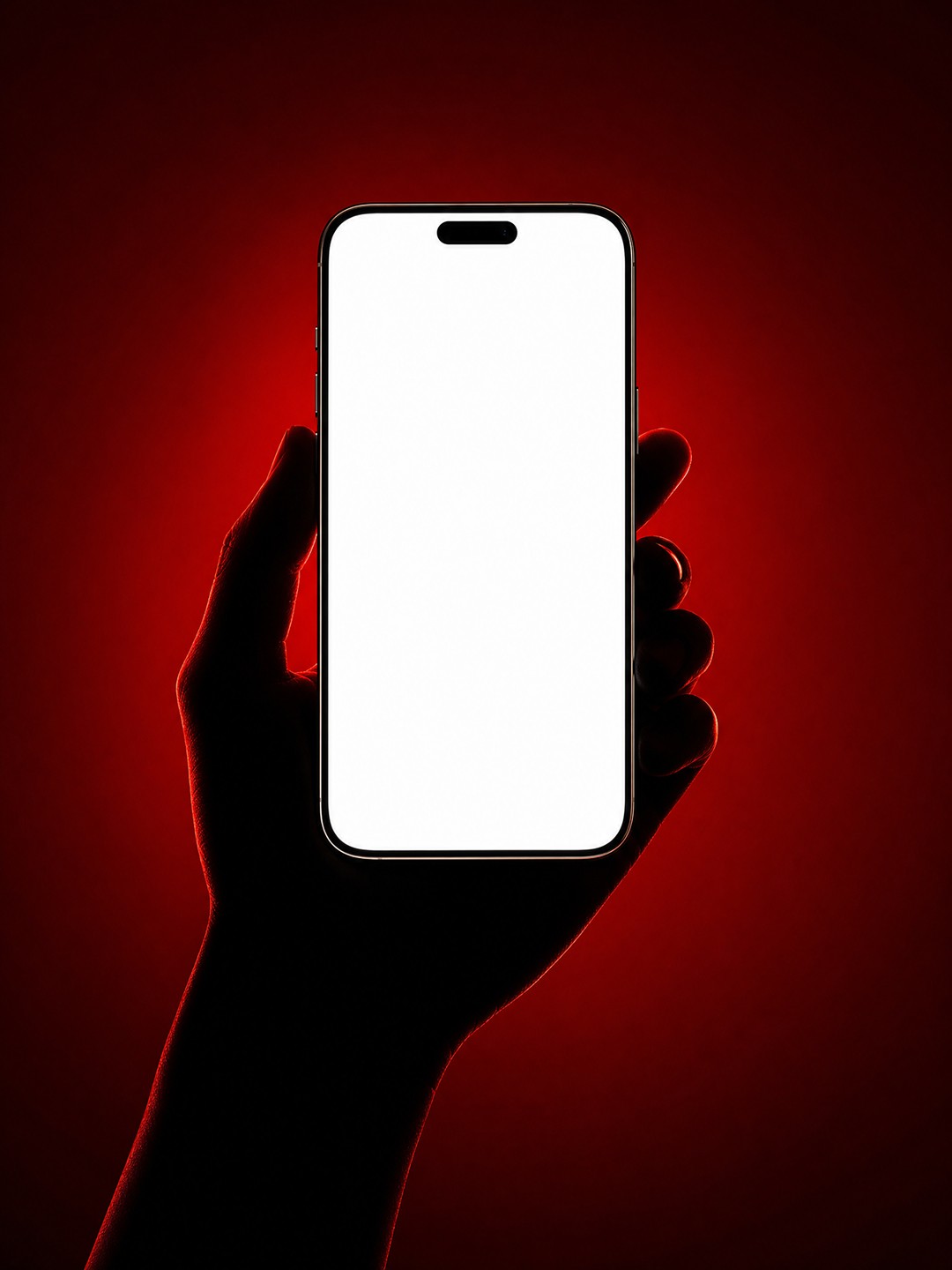
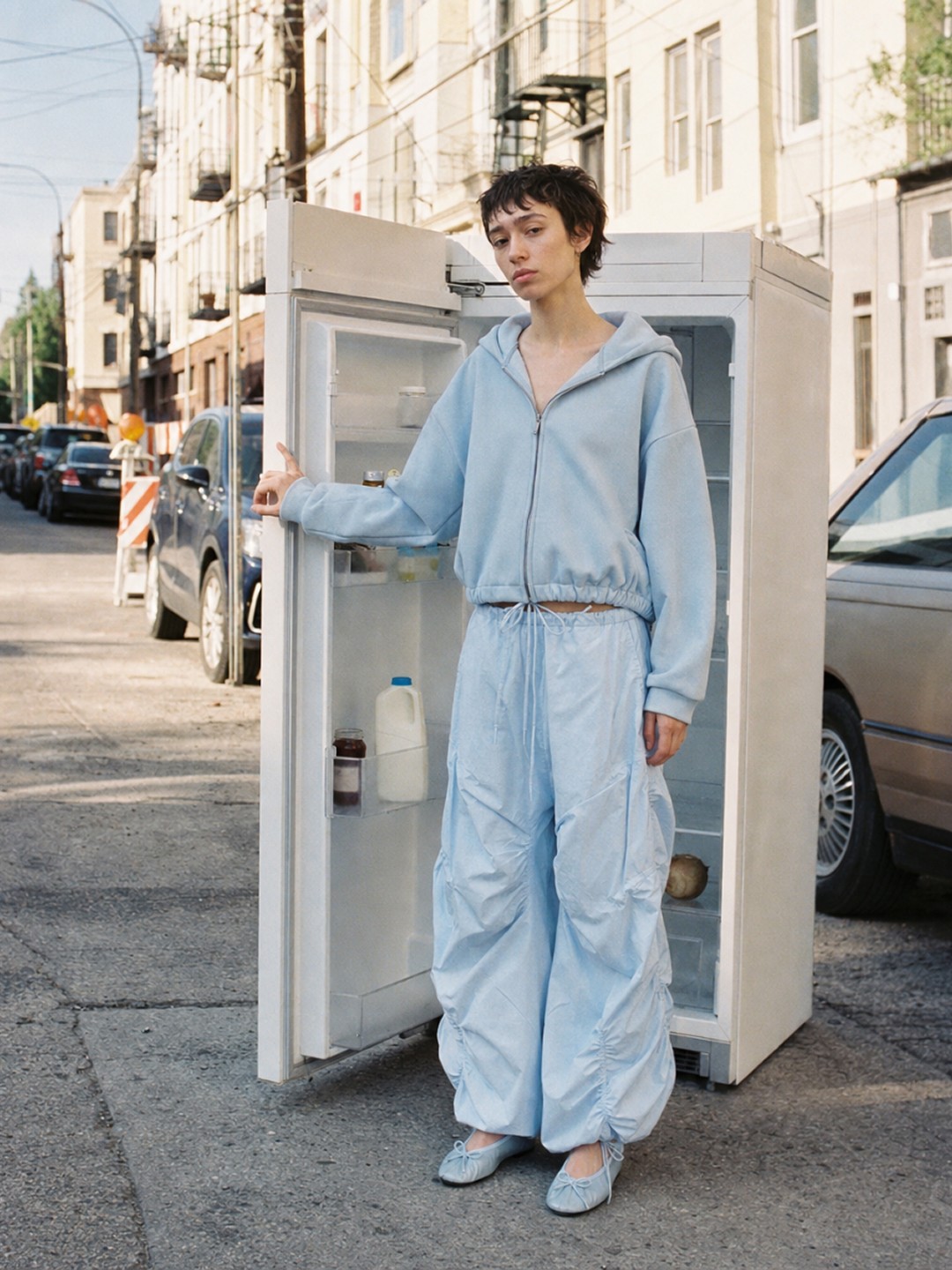
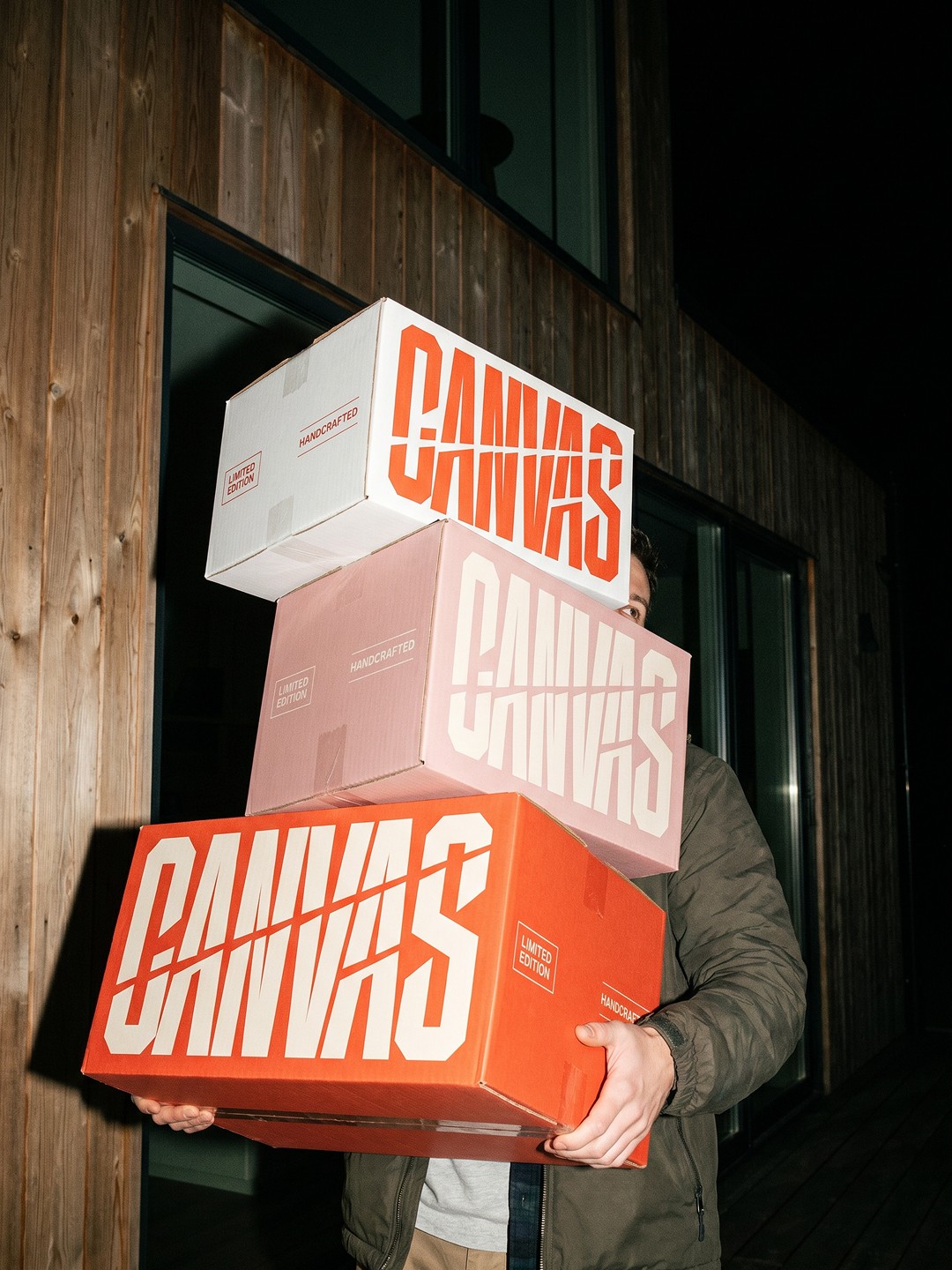
Collection of art-directed graphics
Experimental Graphics
Model
Recraft V4.1 Pro
Category
Design
Resolution
2K
Back


Neural Spectrum
Experimental medical-imaging poster showing a precise 3×3 grid of nine axial brain scan images against a completely pure black background. Each scan should have the same vertically oriented oval composition, centered at equal spacing with generous black gaps between the rows and columns. Show recognizable anatomical brain structures, skull boundaries, ventricles and cortical folds, but render every scan as a false-color scientific heatmap rather than a grayscale MRI. Give each brain slice a distinct pseudo-color palette while keeping the anatomy consistent: red, orange, yellow and green; olive, brown, cyan and pale green; electric blue, violet and magenta; rust, deep blue and turquoise; saturated cobalt blue with pale lavender structures; neon green, yellow, coral and white; purple, cream and dark brown; deep blue, red and emerald green; orange, yellow, black and violet. Use glowing color bands, high-contrast edges, fine pixel noise, scan-line artifacts, slight chromatic bleed and low-resolution medical-monitor texture. Each brain should feel like a different processing mode or neurological dataset. Keep the grid perfectly ordered and symmetrical. No labels, no numbers, no patient information, no UI, no arrows, no text, no logos, no watermark. Pure black background, no surrounding objects, no photorealistic head, no external anatomy, no decorative frame.
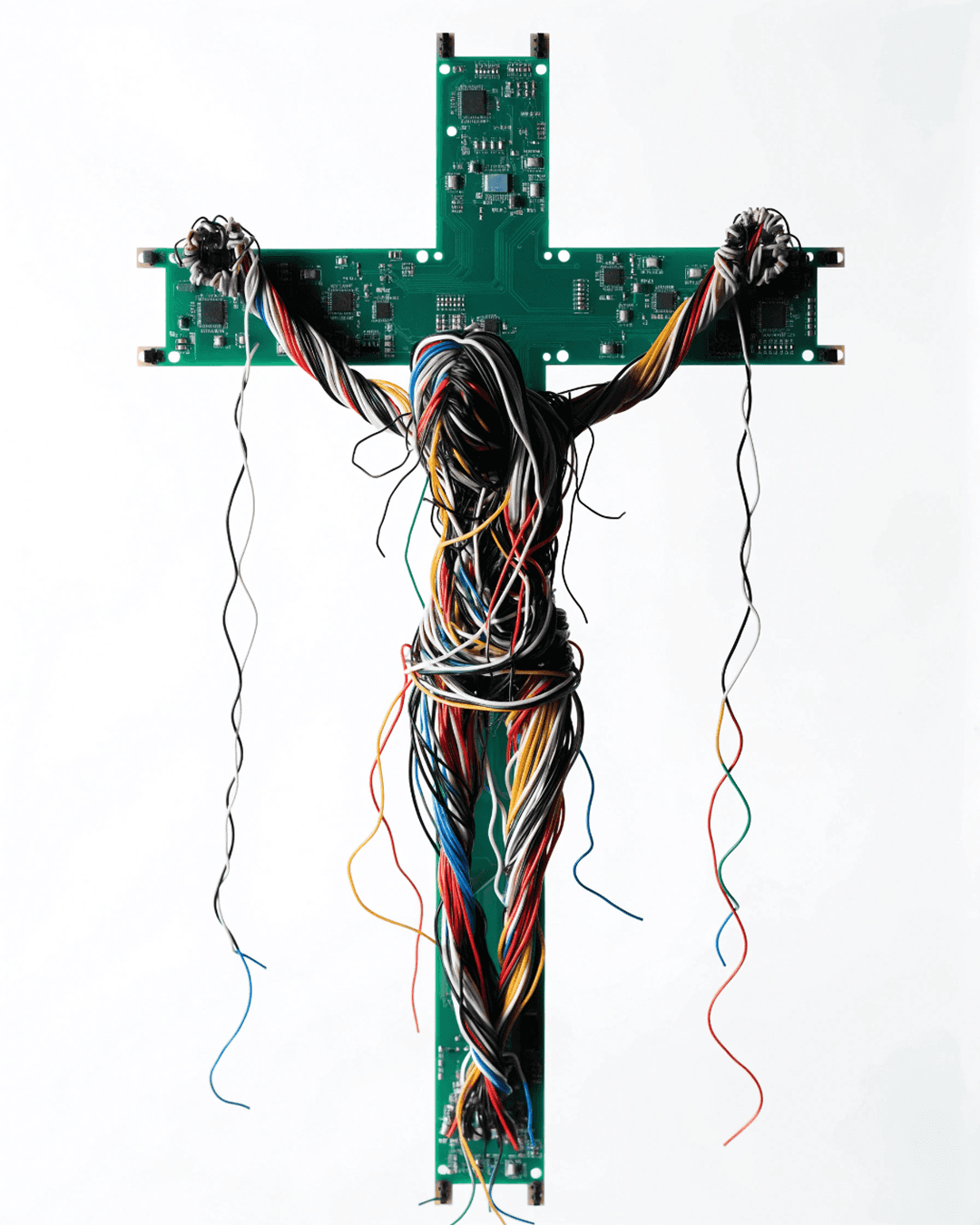

Wired Faith
Conceptual assemblage artwork centered on a crucifix constructed from obsolete electronic components. Build the cross from several narrow green printed circuit boards joined at right angles. The vertical board should be long and slender, while two shorter boards form the horizontal arms. Preserve visible copper traces, solder points, pale-blue resistors, tiny capacitors, chips and black pin connectors at all four ends. Attach a crucified human figure to the front of the circuit-board cross. Construct the entire body from tightly bundled multicolored electrical wires rather than flesh: black, white, red, yellow, blue and green cables twisted together to define the head, torso, arms, hands, hips and long overlapping legs. Stretch both arms upward and outward along the horizontal circuit boards. Let loose wire strands create a bowed head and tangled hair, with no detailed facial features. Photograph the object frontally against a pure white background with a large amount of empty negative space. Use slightly overexposed archival documentation lighting, soft edge blur, faded colors and subtle analog grain. The contrast between sacred iconography and discarded technology should feel solemn, fragile and unsettling. Centered symmetrical composition, handmade cybernetic relic, mixed-media sculpture, late-20th-century technological archaeology. No blood, no wounds, no realistic flesh, no additional religious objects, no text, no frame, no logo, no signature, no watermark.

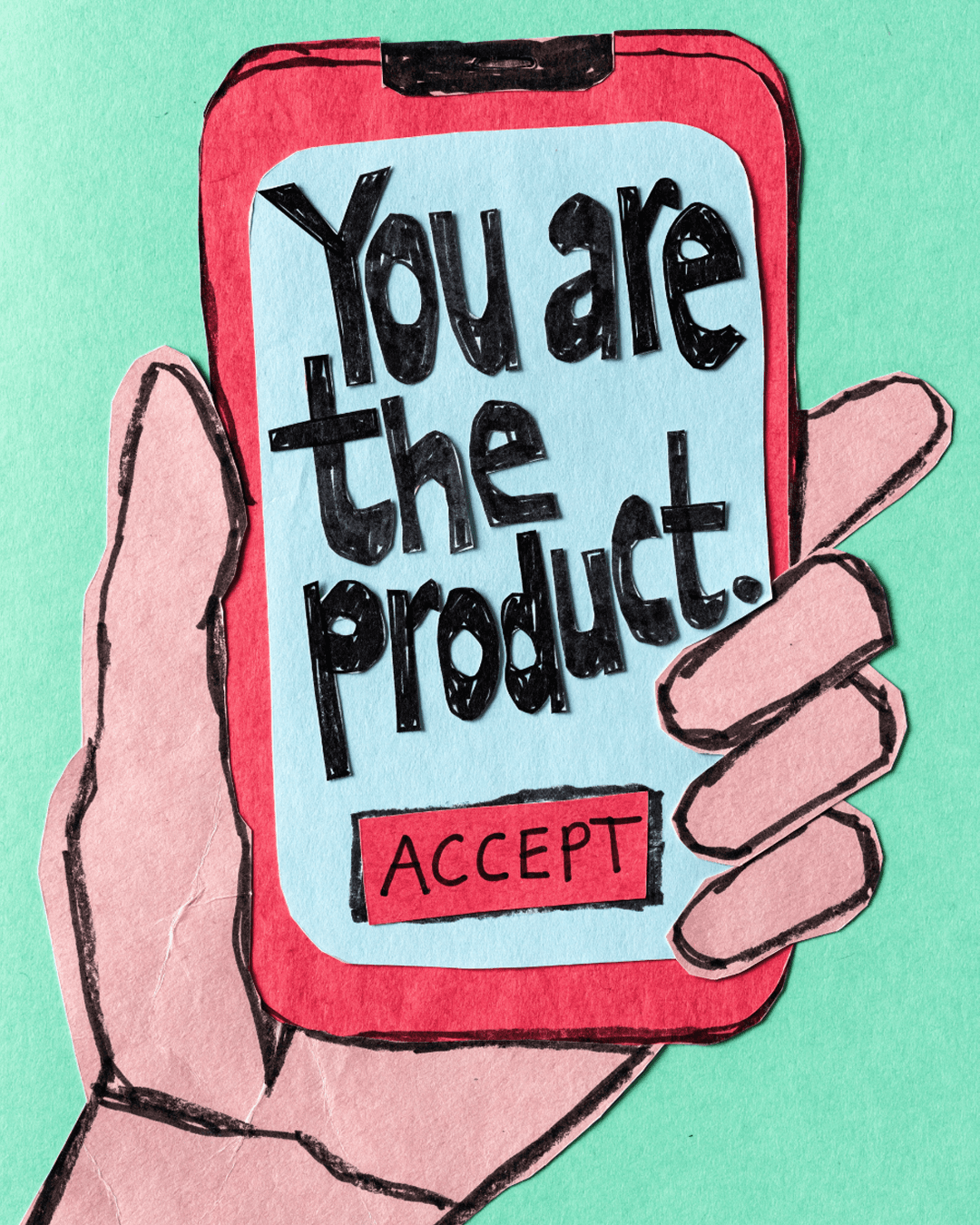
Human Product
Handmade paper-collage illustration of a hand holding a smartphone upright against a flat mint-green background. Construct the hand from layered dusty-pink paper and the phone from thick pieces of vermilion-red card. Use a pale sky-blue screen. Every shape should have imperfect scissor-cut edges, visible paper fibers, slight wrinkles, physical overlaps and small natural shadows between the layers. Add rough black marker outlines that do not align perfectly with the paper shapes. Print only the exact sentence “You are the product.” using individually cut black paper letters. Add one uneven rectangular paper button labeled “ACCEPT”. Playful but unsettling editorial craft aesthetic. No additional objects, interface elements, logo, signature or watermark.
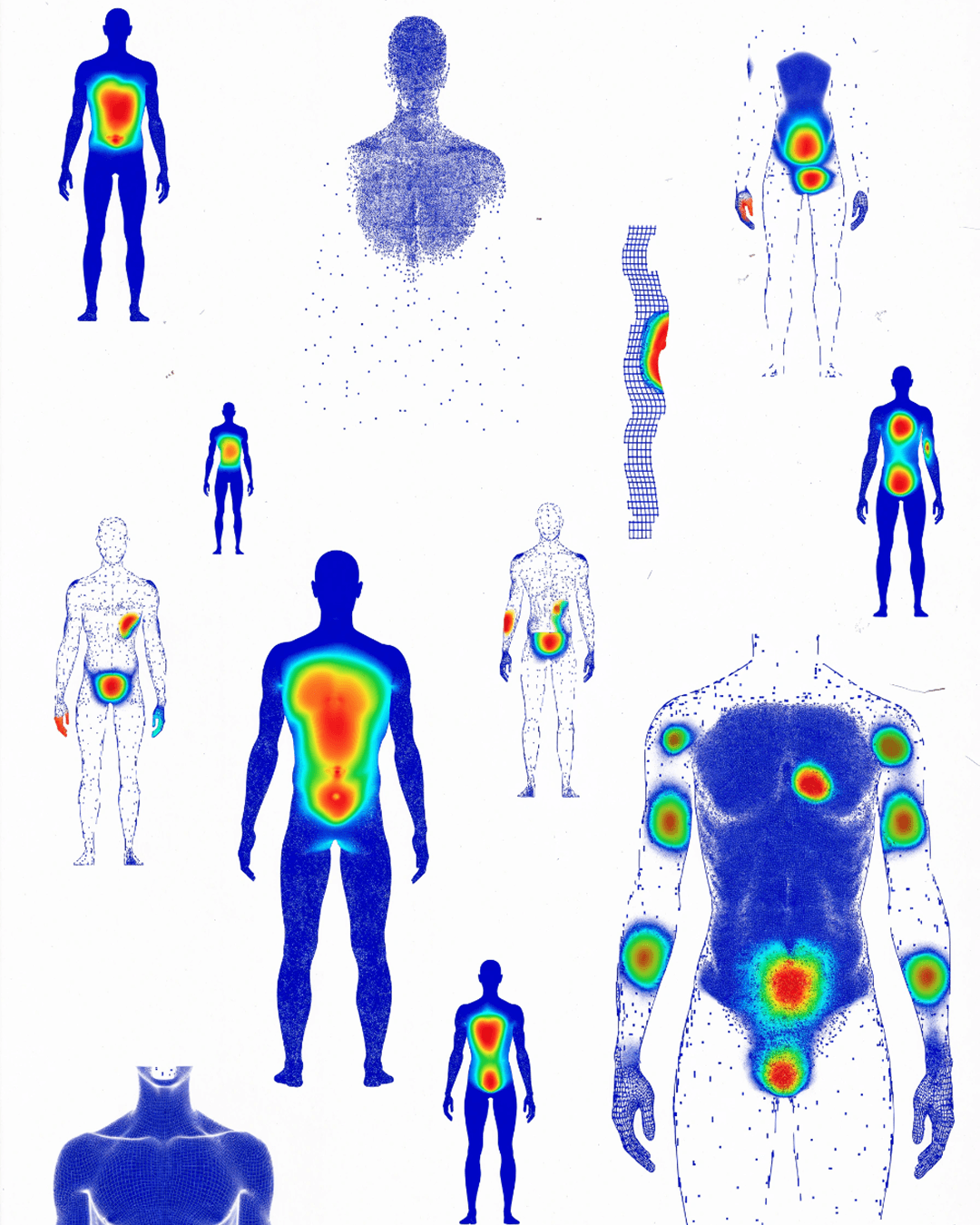

Body Signals
Experimental scientific poster showing a collection of human-body scans and thermal maps arranged freely across a pure white background. Include approximately ten isolated figures and anatomical fragments at different scales: - Several small full-body silhouettes shown from the front, back and side. - One large back-facing body near the center with a broad thermal field spreading across the shoulders, torso and upper legs. - One large three-quarter torso on the right with several separate circular heat concentrations across the chest, abdomen, shoulder and arm. - A simplified upper torso made from a dense blue point cloud. - Two headless wireframe bodies with localized heat patterns around the stomach, lower back and waist. - One curved vertical fragment of a human body rendered as a distorted measurement mesh. - One cropped shoulders-and-neck scan near the lower edge. Construct most of the bodies from tiny cobalt-blue points, short dashes, square pixels and broken wireframe lines, leaving visible gaps in the anatomy. Overlay thermal regions using a scientific heat-map spectrum: deep blue at the outer edges, transitioning through cyan, green and yellow into intense orange and red at the hottest centers. Keep the silhouettes simplified, gender-neutral and mannequin-like, with no facial features or realistic skin. Vary the scanning methods between solid digital silhouettes, sparse point clouds, gridded meshes and low-resolution pixel maps. Use the visual language of early medical-imaging software, motion-capture data and obsolete ergonomic research diagrams. Add slight rasterization, jagged pixels, printing noise, misaligned dots and low-resolution color transitions. Clean white negative space, clinical but visually strange.


Death Loop
Two-color risograph poster featuring two anatomically accurate human skulls arranged in a tight interlocking composition. The larger upper skull is shown in three-quarter side view facing right with its jaw open downward; the second skull is rotated upside down beneath it, facing left with its jaw open upward, so their teeth and jawlines overlap near the center. Print the skulls entirely in dense matte-black ink on intensely saturated fluorescent scarlet-red paper. Build all anatomical detail from crushed black shadows, coarse stochastic grain, photocopier toner, scattered dots and eroded ink rather than clean outlines. Let the red paper show through as the highlights and empty areas inside the skulls. Use rough speckled edges, inconsistent ink density, dusty overspray and subtle misregistration to create a raw analog photocopy and risograph texture. Keep the skull cluster centered with generous untouched red negative space around it. Aggressive underground poster aesthetic, high contrast, imperfect and tactile. No white ink, no gray, no typography, no border, no additional objects, no gore, no smooth gradients, no polished vector lines, no glossy 3D rendering.


Grid Logic
Swiss-modernist editorial poster printed on warm, slightly dirty off-white paper. Build the entire composition around a visible modular grid made from thin electric-blue lines. Place a large rectangular grid panel slightly inset from the outer page margins. Divide it into four equal columns and six horizontal modules. Allow selected modules to merge into larger geometric blocks while keeping the underlying grid structure visible. Fill the upper-right area with a large solid cobalt-blue rectangle spanning approximately two columns and two rows. Add another tall cobalt-blue block in the lower-left corner, spanning one column and two rows. Keep every other module unfilled so the textured off-white paper remains visible. Set the exact main title: “Grid Systems” Use an extremely large, heavy black neo-grotesque sans-serif typeface similar to classic Swiss editorial typography. Align the title to the left grid edge. Place “Grid” across the upper-middle rows and “Systems” directly beneath it, extending almost across the full poster width. Allow the letters to touch or visually intersect the blue grid lines.


Measured Bloom
Editorial poster combining archival botanical photography with a scientific computer-vision interface. Photograph a single pale blush-pink tulip against a completely black background. The flower should be partially open and slightly wilted, with large folded petals twisting into an irregular sculptural form. Show delicate cream, beige, dusty pink and muted brown tones across the petals. Include one long green stem curving diagonally from the lower-left corner into the flower near the upper center. Use harsh directional flash and deep shadows to create an old botanical archive photograph. Preserve realistic petal veins, creases, translucent edges and subtle areas of decay. Add faded film color, dust, scratches, scanner marks and fine analog grain. Overlay a complex white computer-analysis network across the flower and stem. Place dozens of tiny circular tracking points on petal edges, folds and intersections. Connect the points using thin straight white lines, forming an irregular geometric mesh that extends beyond the flower into the black background. Add small outlined rectangular tracking boxes around selected details. Place short strings of decimal coordinates and numerical measurements beside different nodes, using tiny white monospaced typography. The numbers should resemble machine-generated spatial data rather than meaningful labels. Include a few thin partial circles and long technical arcs crossing the outer background. The interface should feel precisely mapped to the organic structure of the flower while remaining visually chaotic and experimental. Contrast the soft decaying botanical subject with cold mathematical analysis. No vase, no additional flowers, no colored interface lines, no readable words, no title, no footer, no designer credit, no logo, no signature, no watermark.


Parallel Terrain
Surreal scientific-art image of four thin square geological landscape slabs floating in a perfectly white empty space. Arrange the slabs in a vertical stack with clear gaps between them. Show each slab from a slightly elevated three-quarter angle, with rough irregular edges, visible thickness and small fragments of terrain breaking away from the sides. Keep the slabs aligned along one central axis but rotate them slightly so their corners do not match perfectly. Each slab should contain a different miniature landscape rendered in false-color satellite and mineral-scan aesthetics: - The top slab: a dark mountain range with sharp peaks, black rock, icy lavender valleys and metallic gold highlights. - The second slab: an abstract flat terrain with concentric topographic layers in violet, cyan, lime green, orange and red. - The third slab: a deep green mountain landscape with bright white peaks, dark valleys and scattered warm amber highlights. - The bottom slab: a rough desert or volcanic landscape with saturated red, orange, yellow, turquoise and black geological bands. Use dense pointillist texture, iridescent mineral speckles, pixel noise, shimmering color transitions and high-contrast scanned-satellite detail. The landscapes should feel physical and rocky, but the colors should resemble a scientific heatmap or psychedelic geological scan.


Web Protocol
Two-color screen-print poster featuring three large spiders suspended on an intricate web. Use only saturated ultramarine-blue ink and warm unbleached cream-white. Cover the entire background with a flat field of intense ultramarine blue. Preserve visible fabric fibers, rough paper grain, roller marks and subtle variations in ink density. Draw a delicate cream-white spiderweb stretching beyond all four edges of the composition. Use extremely thin, imperfect lines with irregular spacing, broken sections and slightly distorted geometry. Position the web’s densest spiral slightly left of center, with additional intersecting web structures expanding across the upper and left sides. Arrange three oversized cream-white spiders in an asymmetrical cluster: - One spider near the upper center, rotated diagonally with long angular legs. - One spider overlapping it on the upper-right, partially cropped and turned in the opposite direction. - One larger spider below them near the center, with a rounded abdomen and legs extending across the central web spiral. Render the spiders as rough stencil-like silhouettes rather than realistic illustrations. Use heavy ink loss, distressed edges, scratched areas, uneven opacity and patches where the blue background breaks through the white bodies. Their forms should remain immediately recognizable despite the degraded printing. Raw handmade textile screen print, two-color punk poster, imperfect registration and tactile analog grain. No additional colors, no gradients, no realistic lighting, no shadows, no plants, no typography, no border, no logo, no signature, no watermark.


Fatal Error
Experimental poster that looks like a corrupted Windows 95 error window printed from an early-1990s office printer. Place a small rectangular software window in the center of a mostly empty, dirty-white paper background, leaving a large amount of blank negative space above and around it. Inside the window, show a front-facing grayscale portrait of an expressionless adult man transformed into a horned demonic figure. Make the face extremely low-resolution and constructed from large square pixels in black, dark gray, light gray and white. The horns rise vertically from both sides of the forehead and partially dissolve into pale digital artifacts. Keep the eyes nearly invisible beneath a thick horizontal band of black pixels, creating an anonymous and unsettling expression. Keep the portrait, background and surrounding image completely monochrome. The Windows popup interface should be the only colored element in the composition. Frame the portrait inside an authentic Windows 95 interface. Use a warm light-gray window body with sharp square corners, one-pixel black borders and raised beveled edges. Add a saturated cobalt-blue title bar across the top with the title “SYSTEM ERROR” in a small white bitmap font on the left. Place three raised gray window controls in the upper-right corner: minimize, maximize and close. Place a classic colorful Windows 95 system-error dialog box across the lower part of the portrait. Use a light-gray panel with bright beveled highlights and dark-gray shadows. On the left, include a vivid red circular error icon containing a bold white “×”. Print the exact sentence in black bitmap typography: “This version of you is no longer available.” Center a raised light-gray rectangular button beneath the sentence containing the exact black label: “OK” The popup should feel unusually vivid against the faded monochrome portrait: cobalt blue, bright red, warm computer gray and crisp white. Preserve authentic low-resolution bitmap UI typography, crude interface geometry, heavy portrait pixelation, photocopier noise, toner dust, faint vertical printer streaks and rough paper grain. Cold, minimal, ominous and technologically obsolete.


Design Wizard
Humorous retro-computer image featuring a low-poly elderly wizard working intensely at an old desktop computer. Place the wizard in the lower-center of the composition, seated at a curved silver-gray office desk. Leave generous empty space above and around him. He has a long pointed nose, thick white eyebrows, long white hair and a large white beard. Dress him in a bright royal-blue robe and an oversized pointed wizard hat covered with small yellow stars and crescent moons. Show him leaning toward a bulky beige CRT monitor, rapidly typing on a compact beige keyboard with both hands. Add a wired mouse, a small brown wand and one tiny green-and-red magical object on the desk. Use a strange ergonomic gray office chair and chunky curved desk legs. Render everything as crude late-1990s 3D clip art: extremely low polygon count, faceted geometry, stiff fingers, stretched low-resolution textures, flat lighting, weak shadows, jagged edges and awkward proportions. Make it resemble an obsolete transparent GIF or a character asset extracted from forgotten educational software. Place the entire scene against a flat medium-gray background with no visible floor, horizon or environment. Add subtle JPEG compression, slight pixelation, rough cutout edges and faint low-resolution noise while keeping the character clearly separated from the background. Intentionally outdated digital aesthetic, awkward composition and deadpan meme mood. Absolutely no text, letters, numbers, typography, captions or interface elements. No magical effects, no modern computer, no realistic rendering, no logo, no signature, no watermark.

Apple-studies
Experimental graphic-design poster on a clean warm-white background, featuring only nine different visual interpretations of a red apple arranged in a precise 3 × 3 grid. Each grid cell contains one isolated apple created with a different design language: Apple outlined with a numbered pink vector path, black anchor points and connected line segments. Apple reconstructed from overlapping cropped photographs, red color blocks and transparent rectangular layers. Apple formed from one continuous loose red spiral line with a small black scribbled stem. Chunky low-resolution pixel-art apple built from large red, coral and pink squares. Apple drawn as a chaotic ball of overlapping red loops and gestural scribbles. Apple constructed from concentric rings of red circular dots with a black dotted stem. Soft abstract apple made from stacked floating red gradient-like horizontal bands, but rendered with printed halftone transitions rather than digital gloss. Geometric faceted apple reduced to an angular red polygon with a dark bent stem and two small diamond-shaped highlights. Glossy-looking apple interpreted through dense red halftone dots, white negative-space highlights and a solid red stem. Keep the apples approximately equal in size, evenly spaced and completely separated from one another. Use a tightly controlled palette of scarlet red, coral, pale pink, black and white. Mix vector diagrams, pixel art, gestural drawing, halftone printing, collage and geometric abstraction while keeping every object immediately recognizable as an apple. Minimal contemporary design-study aesthetic, sharp editorial layout, subtle paper grain and slight analog print imperfections. Apples only. No typography, no numbers, no labels, no captions, no interface text, no people, no additional fruit, no logo, no signature, no watermark.
Full Access
SUMMER PRICE
$10
/ month
$30
Instant access to the full prompt library
Prompt templates and style breakdowns
Model, settings, and my creative notes
Download every image in high resolution
Use the visuals in your own projects and work
Renews monthly. Cancel anytime.