Collection of art-directed graphics
Experimental Graphics v2
Model
Recraft V4.1 Pro
Category
Design
Resolution
2K



Joy in the Climb
Create a vertical 4:5 colorful risograph poster inspired by the myth of Sisyphus. Place a small simplified human figure in the center-left, struggling upward along a steep diagonal hill. Show the person leaning back dramatically with both arms raised, pushing an enormous circular boulder that occupies most of the upper half of the composition. Keep the anatomy loose, awkward and expressive, with one leg extended downhill and the other bent against the slope. Draw the figure and landscape with rough hand-inked contours rather than polished vector lines. Use broken strokes, accidental gaps, uneven pressure and gestural marks to communicate effort and movement. Make the boulder a large fluorescent orange-red circle with irregular cobalt-blue halftone shadows and patches of acid yellow. Render the hill in deep ultramarine with loose turquoise strokes and black-purple shadow marks. Color the person warm cream with overlapping coral and bright-green accents. Use a pale lavender-pink uncoated paper background. Print with a bold four-ink risograph palette: fluorescent orange, electric blue, bright green and violet-black. Allow the inks to overlap and create unexpected secondary colors. Emphasize strong registration errors, porous soy-ink texture, visible dot screens, roller marks, faded patches, paper fibers and rough edges. At the bottom, print the exact uppercase message: “FIND DELIGHT IN PUSHING YOUR ROCK UP YOUR HILL” Use a heavy rounded sans-serif typeface in deep violet-black. Set it across two centered lines with tight spacing and slightly imperfect printed edges. Keep the visual language naive, philosophical and optimistic—like a handmade independent-press poster rather than a polished motivational graphic.


Rebuilding the Past
Experimental architectural poster about a city building its future from what it erases. Use a warm-white background with generous negative space. Place two equal-height towers side by side in the lower two-thirds of the composition. On the left, show a speculative contemporary tower as a translucent coral-red structural model: exposed steel frames, diagonal braces, floor plates, stairs, scaffolding grids, and several suspended solid volumes. Keep it partially transparent with precise axonometric linework and crimson overlaps. On the right, show a heavy early-20th-century masonry skyscraper in dusty slate-blue photographic halftones. Include repetitive windows, setbacks, balconies, eroded shadows, and a small rooftop antenna. Turn the comparison into a visual transformation. Let windows, façade panels, and masonry fragments detach from the historic tower’s left side and drift across the gap. As they approach the contemporary tower, gradually transform them into coral structural modules, beams, and suspended rooms. Avoid obvious arrows; make the transition feel architectural and inevitable. Inside the red tower, embed a faint blue silhouette of the historic skyscraper, like an architectural memory trapped within the new structure. Allow several blue windows to remain visible inside the red framework. Keep the old tower solid at its outer edge but increasingly fragmented toward the center. Make the new tower open and skeletal at its outer edge but denser where it receives fragments from the past. Their shared central overlap should become the conceptual focus. Across the bottom, create a broken city layer that transitions from blue historic rooftops, trees, and a small church beneath the old tower into coral grids and abstract construction beneath the new one. Let both sides dissolve into rough dots and exposed paper. Use only coral red, crimson, dusty slate blue, and warm white. Combine architectural drawing, archival photography, blueprint reproduction, coarse halftones, faded ink, paper grain, and slight misregistration.


The Noise Within
Create a vertical 4:5 surreal analog image with no text. Place a solitary seated human figure in the center of a nearly black indigo room. Show the body from the waist up, facing directly toward the viewer with relaxed shoulders and hands resting together near the lap. Make the entire figure emit an intense cyan-blue glow. Erase all facial features beneath overexposed light, turning the head into a smooth luminous silhouette. Surround it with many thin, chaotic cyan lines orbiting in irregular loops, resembling tangled thoughts, electrical signals, or long-exposure light drawings. Allow faint linear marks to cross the upper part of the head, but keep them abstract and non-typographic. Place several barely visible shadowy human forms around the outer edges, cropped and out of focus, as if silently observing the glowing figure from the darkness. Render the scene like a damaged analog photograph printed on coarse fabric: heavy grain, visible canvas weave, color bleeding, soft cyan bloom, underexposed shadows, faded patches, dust, scratches, and imperfect ink coverage. Use a restricted palette of electric cyan, deep navy, muted teal, and black. Quiet, introspective, mysterious, and slightly unsettling. No words, letters, numbers, captions, symbols, logos, signatures, borders, or watermarks.


The Web Between Us
Degraded vintage print showing a giant spider with a captured human figure. Place an oversized spider across the lower-right half of the composition, viewed from the side, with long angular legs spreading across the frame. On the left, show a much smaller human figure hanging upside down from the upper edge, tightly wrapped in spider silk. Bend the body toward the spider and connect both figures with one thin curved web strand. Keep the composition sparse, tense, and dominated by the extreme difference in scale. Surround the figures with a large field of empty printed texture. Render the image as a primitive two-color screen print repeatedly copied through an old Xerox machine. Use only bright fluorescent aqua-cyan and saturated deep ultramarine. Flood the background with intense cyan and cover it with a dense micro-halftone grid resembling woven fabric or enlarged newsprint. Print the figures in rich ultramarine, approaching blue-black only in the heaviest overlaps. Use crude trembling contours, naive anatomy, scratched cross-hatching, clogged ink, broken edges, missing toner, and thin misprinted web lines. Add dot gain, ink bleeding, paper fibers, accidental scratches, uneven coverage, rough cropping, and slight color misregistration. Keep the colors vivid, electric, and highly saturated—never pastel, gray, sepia, or washed out. Raw underground publication, fluorescent 1970s screen print, low-fidelity Xerox aesthetic. No text, additional colors, scenery, gradients, realism, logos, signatures, borders, or watermarks.

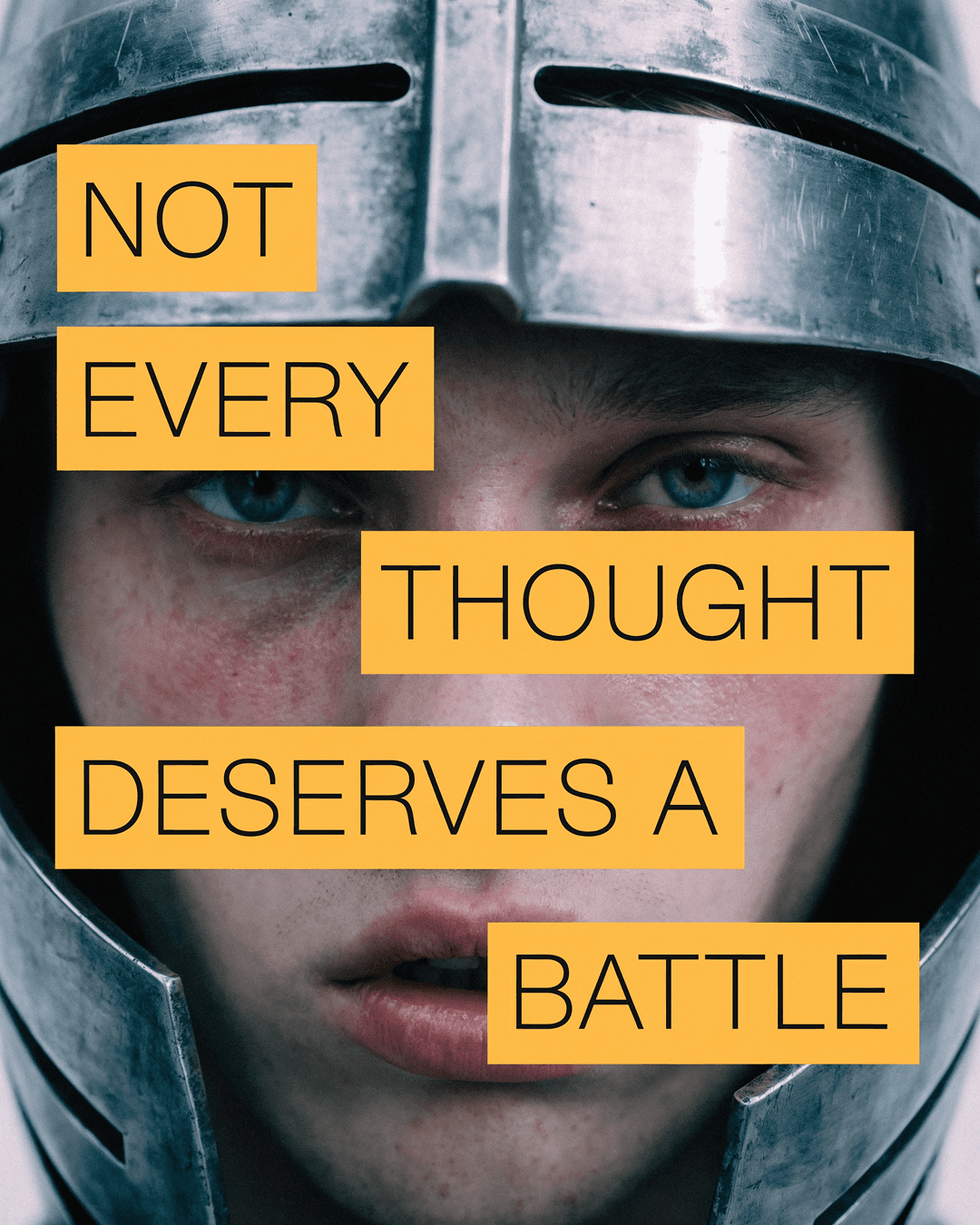
Choose Your Battles
Create a vertical 4:5 confrontational fashion-editorial portrait with bold typographic overlays. Fill the frame with an extreme close-up of an extremely sad, tear-stained young man wearing a medieval steel helmet, photographed straight-on. Crop the top of the helmet and the lower part of his shoulders so the eyes, nose, mouth and surrounding armor dominate the composition. Use a historically inspired late-medieval helmet with a heavy riveted steel construction, worn edges, dents, scratches and a raised visor. Let the metal cheek plates tightly frame the face while leaving the eyes, nose and mouth visible. Add narrow ventilation slits, articulated plates and dark cavities around the sides, but avoid an overly decorative fantasy design. Give the man an exhausted, emotionally distant and slightly defiant expression. He looks directly into the camera with pale gray-green eyes, heavy reddish eyelids and visible under-eye shadows. Keep his exposed skin natural and imperfect, with pores, faint freckles, subtle redness and no makeup. Use flat, soft frontal lighting with muted contrast and the intimate feeling of an unretouched phone-camera portrait. Let the cold metal reflect broad soft-gray highlights without glossy cinematic lighting. Add slight digital softness, low-resolution compression, subtle grain and washed skin tones. Place five separate fluorescent acid-orange text boxes across the center of the portrait, covering parts of the helmet, nose, cheeks and upper mouth. Give every box slightly rounded corners with no outline. Arrange them in an irregular stepped structure rather than one conventional paragraph. Print the exact black text: “NOT” “EVERY” “THOUGHT” “DESERVES A” “BATTLE” Set each word in a large black neo-grotesque sans-serif with regular weight and tight spacing. Keep the boxes aligned loosely but deliberately, allowing small gaps of skin and scratched steel to remain between them. The vivid acid-yellow typography should be the only strongly saturated color in the image, sharply contrasting against the subdued skin and cold gray armor. The words should feel digitally pasted over an old warrior’s face—direct, absurd and slightly humorous. Keep the result contemporary, raw and anti-polished, like an independent fashion campaign combining medieval armor with modern creative anxiety.


Strings Attached
Minimalist conceptual poster with a completely flat, saturated blood-red background. Place a small black human bust at the exact center near the lower edge. Show the figure frontally from the chest upward as a featureless silhouette with narrow shoulders and an upright posture. Replace the face with a dense circular knot of thin white thread. From the far left and right edges, introduce two enormous black hands reaching inward toward the figure’s head. Crop both hands at the wrists. Give them long, elegant fingers held in precise pinching gestures, as though they are pulling, tightening and controlling the thread around the person. Stretch numerous fine white strings between the fingertips and the central figure. Let some lines form a chaotic tangled sphere around the head while others wrap tightly around the neck, shoulders and torso. Mix straight tension lines with loose loops, overlapping curves and delicate knots. The web should feel intentionally manipulated rather than naturally formed. Use an extremely limited palette: flat crimson red, dense matte black and thin chalk-white lines. Keep the silhouettes hard-edged while allowing the thread to look fragile, uneven and hand-drawn. The image should communicate psychological control, overthinking and invisible external pressure. Make it stark, theatrical and immediately readable, like a mid-century political poster combined with contemporary editorial illustration.


The Spark and the Fire
Create a vertical 4:5 two-color underground editorial poster printed on intensely saturated electric-blue paper. Place two simplified human figures seated face to face in the center of the composition. On the left, show a completely warm-white figure sitting upright on a thin round stool. Render the body as a flat featureless silhouette with only minimal electric-blue marks defining the arm, legs and clothing folds. Surround the head with a circular burst of thin white rays. Print a tiny text: “AN IDEA IS ONLY A SPARK.” On the right, show a completely electric-blue figure seated on a rough white rectangular crate, leaning slightly forward toward the other figure. Surround the entire body with a tall vertical field of wild warm-white flames. Add a smaller burst of white rays emerging from the figure’s chest, representing sustained obsession. Print a tiny text: “OBSESSION KEEPS IT BURNING.” Keep the figures close enough to suggest an intense private conversation, but do not let them touch. Use no facial features or realistic anatomy.
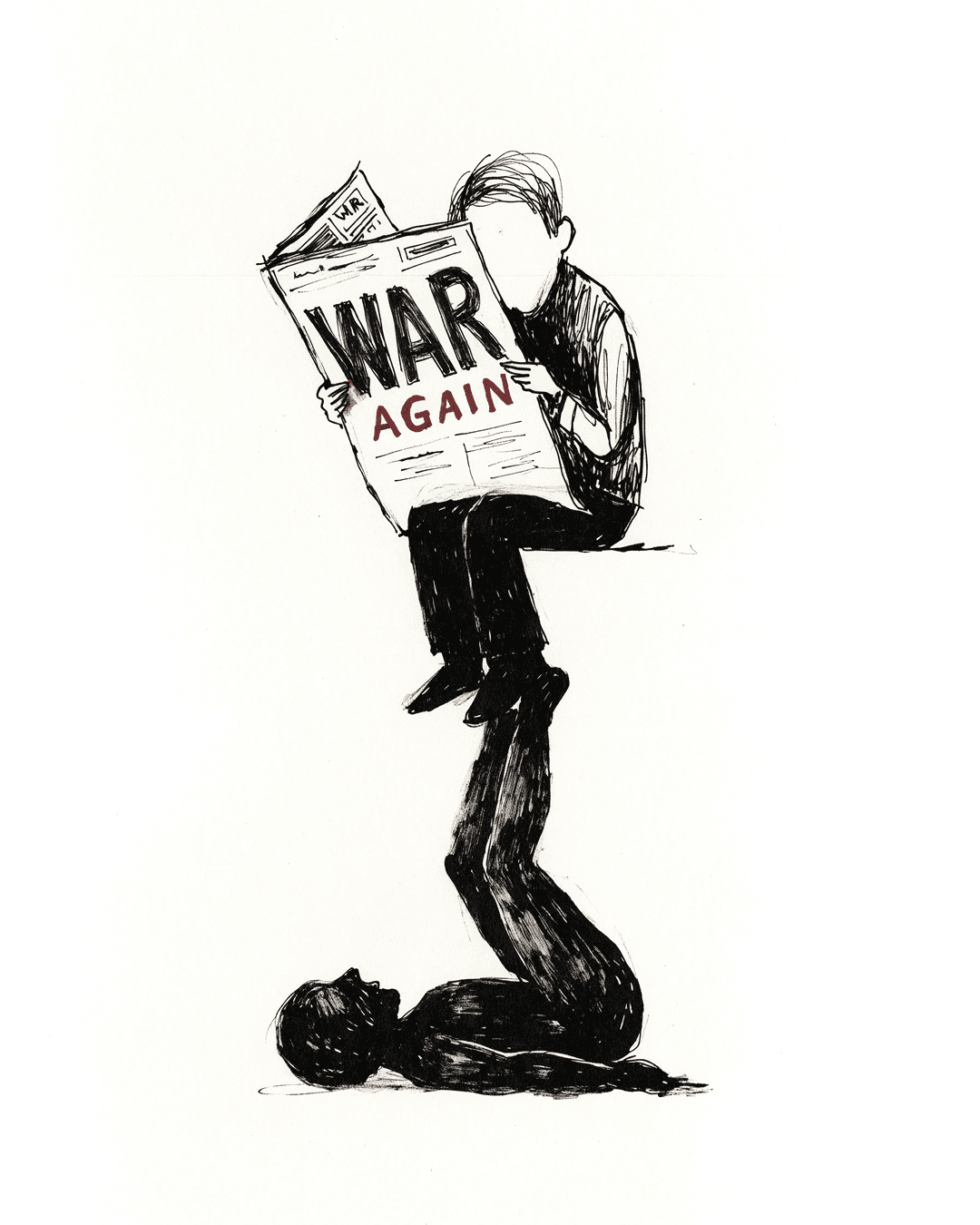

News That Buries Us
Conceptual editorial illustration about the distance between consuming war as news and experiencing it as reality. Use a mostly empty warm-white background. Place a small anonymous young reader in the lower half of the composition, calmly holding an oversized open newspaper. Render the figure with nervous black ink lines, crude anatomy, unfinished contours, and dense scratched shadows. Keep the face almost blank, with the eyes erased by white paper. Print one simple headline across the newspaper: “WAR” “AGAIN” Show the reader unknowingly sitting on the back of a collapsed human figure. Integrate the metaphor physically: let the newspaper’s lower edge unfold into the arms, back, and head of the person beneath. Make the heavy black ink from the headline bleed downward through the paper and gradually become the body’s silhouette, as if the reported war is turning into a real casualty. Keep the lower figure non-graphic but unmistakably human, compressed beneath the reader’s weight. Merge their shapes so the newspaper, the reader’s dark clothing, and the collapsed body form one continuous mass of black ink. Use only black ink and exposed warm-white paper, with one restrained dark-red accent limited to the word “AGAIN.” Apply rough photocopy grain, dry-brush scratches, broken lines, uneven ink density, accidental smudges, and faded print edges. Minimal, uncomfortable, poetic, and immediately readable: for one person war is a headline; for another it is the ground beneath them. No additional text, scenery, furniture, logos, signatures, borders, or watermarks.


Stages of Becoming
Minimalist experimental poster illustrating three stages of metamorphosis. Use a dense yellow background with visible fibers, uneven ink coverage, dust, scratches and slightly worn edges. Arrange three white biological silhouettes horizontally across the middle of the composition: - On the left, a curled caterpillar viewed from above, with a segmented body, small legs and irregular striped markings. - In the center, a compact hanging chrysalis with an asymmetrical organic shape and one large black marking. - On the right, a fully developed butterfly shown frontally with both wings spread wide, delicate antennae and simplified black patterns across the upper wings. Increase the scale of each stage from left to right. Keep wide, deliberate gaps between the three forms so the transformation reads as a quiet visual sequence. Render every subject as a rough white stencil or damaged screen print rather than a clean illustration. Use broken edges, missing ink, black cutouts, coarse halftone texture and imperfect anatomical detail. Near the bottom center, print the exact uppercase phrase: “METAMORPHOSIS OF THE SELF” Use a small hand-cut sans-serif typeface in warm white, with slightly irregular letters and generous tracking. Keep the text isolated beneath the three stages. Add a few tiny accidental white ink specks across the black background. Raw, symbolic and introspective, like an image reproduced in an underground psychology journal or handmade artist’s book.


Success.exe
Create a square minimalist Y2K computer graphic about persistence on a completely flat muted-teal background. Scatter approximately twelve Windows 95-style error dialog boxes across the entire frame. Place them at different positions and slightly varied scales, with several cropped by the outer edges. Let some windows overlap in loose, chaotic clusters while others float alone. Avoid a grid, cascade or orderly pattern—the failures should feel unpredictable and difficult to navigate. Make every surrounding dialog an error window. Give each one a saturated cobalt-blue title bar with the exact white bitmap label: “Error” Inside every error window, print the exact black bitmap message: “Fail” Add one raised light-gray button labeled exactly: “OK” Keep enough of each window visible for the repeated “Error” and “Fail” messages to remain readable. Vary the amount of overlap and cropping while preserving the rigid rectangular geometry of the interface. Place one success dialog precisely in the center of the composition, above every overlapping error window. Make it slightly larger than the surrounding dialogs and leave a small area of teal negative space around it so it becomes the immediate focal point. Construct the central window with the same sharp square corners, chunky one-pixel black borders and classic raised beveled edges. Change its title bar to saturated emerald green and print the exact white bitmap title: “Success” Place one raised light-gray close button containing a black pixelated “X” in the upper-right corner. In the center of the pale-gray window body, print the exact black bitmap message: “You kept going.” Below it, add one wide raised rectangular button labeled exactly: “fuck yeah” Place a dotted focus rectangle inside the button and an old-school Windows cursor. Keep the error windows chaotic and visually noisy, while the success window remains centered, unobstructed and completely readable. The composition should suggest that success exists not after failure disappears, but in the middle of continuing failures. Use authentic low-resolution interface graphics: nearest-neighbor pixels, crude bitmap typography, hard-edged computer gray, simple black shadows, slight CRT softness, compression artifacts and faint color fringing.


Inner Weather
Experimental fashion-editorial cover with a soft, cold, overexposed atmosphere. Place a young woman centrally against a flat pale blue-gray studio background. Frame her from the chest upward, facing directly toward the camera with her head turned only slightly to the right. Give her an emotionally distant expression and very pale blue eyes looking upward past the viewer. She wears a fluffy white knitted balaclava that closely frames her face and completely covers her hair, ears and neck. A short line of blunt pale-blonde bangs remains visible across her forehead. Dress her in an oversized thick ribbed sweater in soft gray-beige wool with a tall funnel neck and a short black zipper at the center. Use diffused frontal lighting with almost no hard shadows. Make the skin extremely pale with softly flushed pink cheeks and nose. Apply subtle film grain, slight blur, washed highlights, muted contrast and the fragile texture of a scanned late-1990s fashion magazine. Add small red typographic annotations around the portrait. Use a compact bold neo-grotesque sans-serif in uppercase, tightly set and aligned like an experimental album track list. Repeat the following exact blocks several times around the top-left area and across the space beside her face: “01 STATIC BETWEEN THOUGHTS INNER WEATHER” “02 BORROWED MEMORIES KEEP REPEATING” “03 THE FUTURE ARRIVED WITHOUT WARNING” “04 BECOMING SOMEONE I ALREADY WAS” Arrange the text in irregular stepped clusters, with the numbers separated from the titles and large areas of open space between repetitions. Keep the typography small, red and secondary to the portrait. Minimal icy palette of pale gray-blue, warm white, muted beige, soft pink skin and signal red typography. Quiet, futuristic, intimate and slightly alien.


The Space We Left
Minimalist conceptual photo collage against a completely flat, saturated vermilion-red background. Place one rectangular documentary photograph in the lower-left half of the composition. The photograph shows a quiet, neglected urban corner with a concrete wall, vertical wooden panels, sparse trees, cracked pavement and muted gray-beige colors. Inside the photograph, remove a woman and a man from the original scene and replace their bodies with perfectly flat vermilion-red silhouettes matching the surrounding background. Preserve their recognizable full-body outlines standing close together, but erase all internal detail so they appear as empty human-shaped cutouts punched through the photograph. To the right of the photograph, place the removed couple as clean full-body photographic cutouts floating directly on the red background. Show them from behind, standing shoulder to shoulder and calmly examining the empty silhouettes they left behind. Their inner hands are loosely joined between them, while their outer hands rest behind their backs. The woman is middle-aged, with short silver-gray hair, wearing a pale cream blouse, a dark calf-length skirt and simple black shoes. The man is middle-aged, with short gray hair, wearing a charcoal short-sleeved shirt, dark trousers and black shoes. Keep their styling understated, realistic and timeless. Maintain approximately the same scale between the couple and their missing silhouettes, but shift them horizontally to create a clear visual relationship between presence and absence. Use extremely subtle natural shadows around the photographic cutouts without introducing a visible floor or horizon. Extremely restrained editorial composition with large areas of uninterrupted red negative space. Conceptual, quiet, intimate and slightly surreal, combining documentary photography with hard-edged digital removal.
Full Access
SUMMER PRICE
$10
/ month
$30
Instant access to the full prompt library
Prompt templates and style breakdowns
Model, settings, and my creative notes
Download every image in high resolution
Use the visuals in your own projects and work
Renews monthly. Cancel anytime.